


Getting Clear on Your Gaps


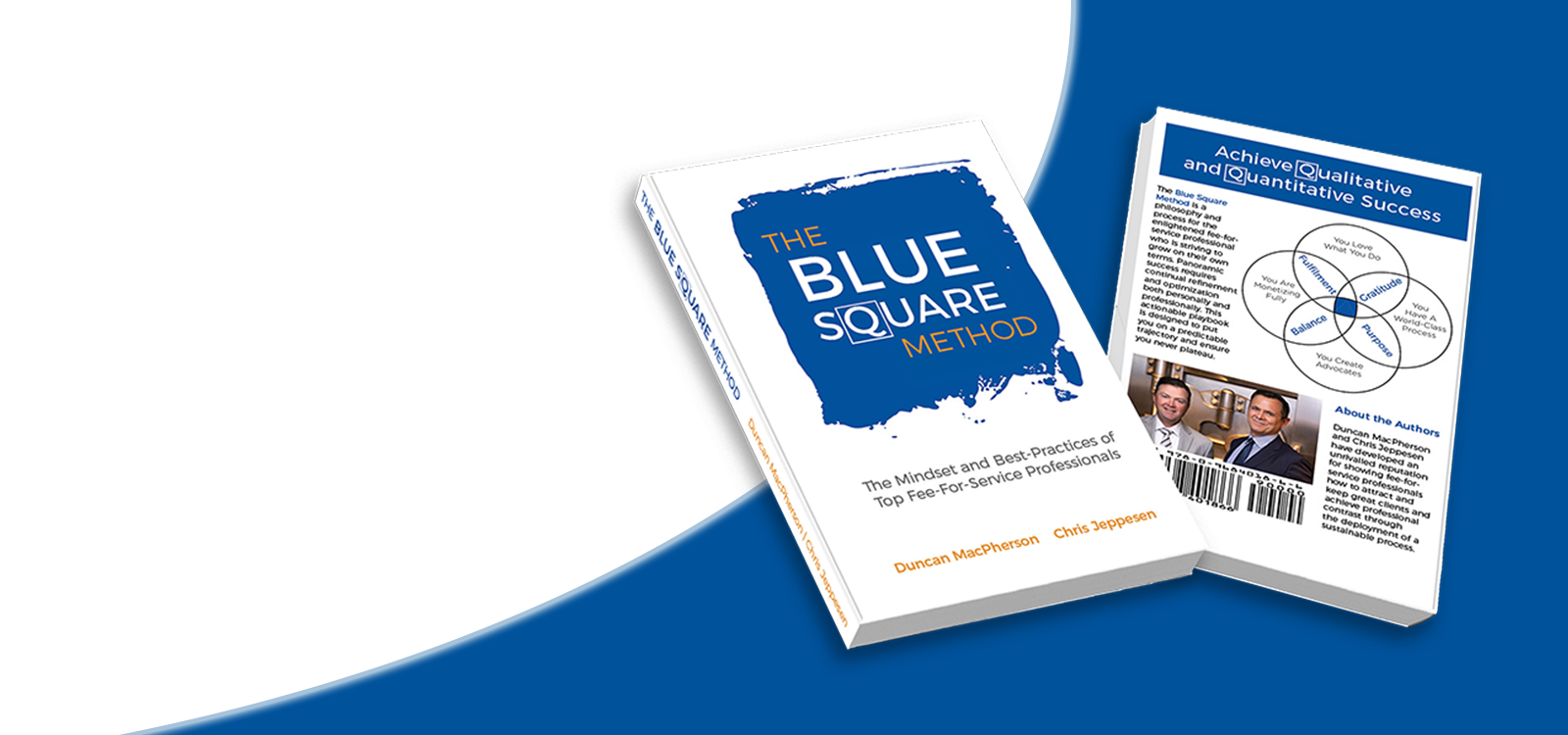
An Excerpt from Duncan MacPherson’s book The Blue Square Method
Let’s pop the hood on your business to gain clarity on the specific actions you can take to unlock another level of productivity and efficiency. We follow the identical format that we use with a consulting client engaged in the early stages of our process. We approach it this way because virtually all of our clients come to us with more issues around breaking through a plateau than in addressing specific problems. It’s not that they have fires they are trying put out, or mistakes they are trying to remedy – they have a good business but they want to be more deliberate and intentional around pre-empting future growth ceilings and insulating themselves from possible lightning strikes. They are also mindful that they are approaching or have hit a self-imposed limitation and, in their current model, they have simply run out of hours in the day.
As you can see from the icon below, there are four quadrants to our model. This is a more panoramic approach than a SWOT analysis because, again, our clients typically already have a good grasp on their strengths, weaknesses, opportunities and threats. This is designed to clear up what the next level looks like and how to get there, while fine tuning their own trajectory towards the Blue Square.
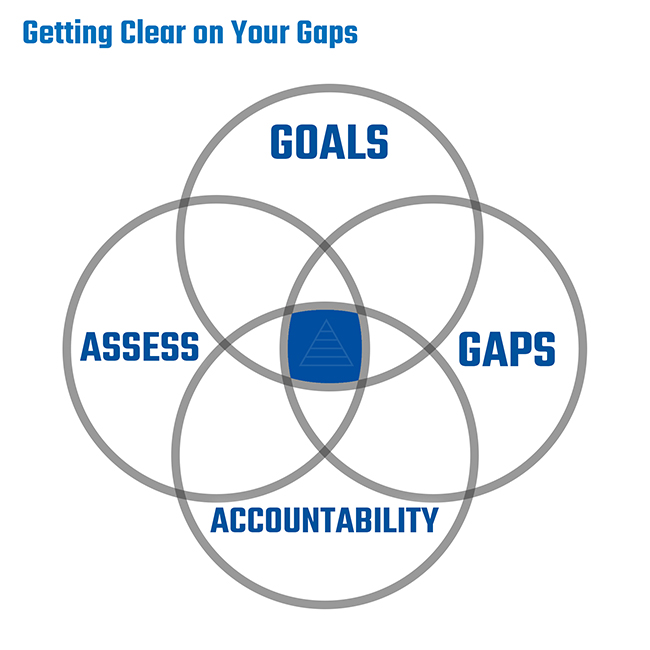
As you do with your clients, the first step is to get clear on specific goals – personally and professionally - to galvanize the ‘why’ even further. Like any attempt to climb a summit, the effort can get intense and the needs more complex the higher you go. The beacon you establish for yourself creates a force that helps you avoid distractions or fall victim to subconscious drift.
The next step is to get crystal clear on specific gaps that you need to address. We generally set a goal of identifying six to eight gaps that can be dealt with in 90 to 120 days. Addressing one gap by itself generally won’t lead to a breakthrough, but as a composite, addressing six to eight can cumulatively be profound, and be mindful of the progress paradox – addressing six to eight can reveal another six to eight.
The rubber hits the road when you shift from a mindset of “intent” to “implement” to hold yourself accountable. This is the launch pad where you look closely at how you allocate time, how you will disrupt your patterns to find another gear, and how you will engage others.
Lastly, you will assess your progress. This is where you will identify specific Key Performance Indicators (KPI) that are both meaningful and measurable. As you know by now, we want you to make both quantitative and qualitative progress.
Strategic Goal Setting for Financial Advisors: The W5 Process
If you reflect on the initial three questions we posed earlier (Are you today where you said you were going to be 5 years ago? What does nirvana look like for you in the next 5 years? Why is that so important to you?), you kick-start the goal-setting process. Just the exercise of thinking it through is beneficial. Synching that up with the ikigai questions can take you a bit further. Let us round it out with our deeper dive W5 goal-setting process so that you can galvanize your vision to paper.
W5 is not unlike the method journalists use to assess a story and reveal key points. Framed in five questions, we’ve seen clients use personalized variations themselves, for their team members, with their clients and even with their kids to help design and navigate the future.
What: Recognize Your Achievements
The first question is “what.” What are you grateful for? It is powerful to invest your past into the future, if for no other reason than to activate a level of gratitude for what you’ve already accomplished in life. It’s a good idea to take a moment to savor our achievements and good fortune so that we don’t take things for granted. This allows us to tune out the noise, smell the roses and to add meaning to the things we hope to achieve going forward. This brings us to quite possibly the most concise concept we’ve ever seen to summarize human aspiration – Maslow’s hierarchy of needs:
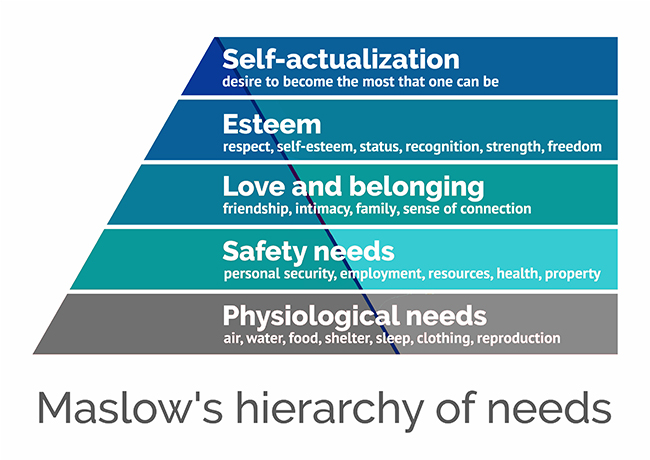
Finally, and something we will keep alluding to, the achievement of esteem is the gateway to the highest aspiration, self-actualization, attaining the best version of ourselves. There are many layers and meanings to this, all of which are very personal. It lines up perfectly with the Blue Square of both qualitative and quantitative success, but it goes deeper.
Self-actualization also helps govern our aspirations and aligns them with our purpose. This goes beyond fashioning a moral compass. It’s about the integrity of balancing service to others along with service to self.
Where: Define Your Personal and Professional Goals
It’s never too late to create a wish list of things you want to achieve, places you want to go and items you’d like to acquire. There is something self-fulfilling about writing 10 things down and looking at them. This exercise helps to make the aspirations real and conceptual, and also makes them attainable.
The best way to prompt you to draw out a Wish List (a great Pearl Jam song btw) of 10 or more meaningful goals is to frame them in FORM. Write out the acronym vertically and start populating your Family, Occupation, Recreation and Money goals. You activate something when you take this simple step and it is integral in fashioning your ideal life.
When: Establish a Timeline for Your Goals
From there, the next question is “when” - when do you hope to achieve the goals on that wish list? Casually give each an approximate time line. It’s not that the timeline is etched in stone, but it should help you sift through your planning based on importance and urgency. Some goals will be short-term, others mid- or long-term. Others may remain open-ended. It’s an exercise to turn the lens to create more focus and clarity, not to make an etched-in-stone blueprint. It also tempers expectations to revisit cause and effect yet again. As always, the enlightened are at peace with the ‘when’, yet unrelenting on the ‘where’.
Why: Connect Your Goals to Your Purpose
The shift to meaning and purpose is activated further by asking yourself “why” - why is all of this so important to you? Carl Jung said that the privilege of a lifetime is to become who we truly are. Getting clear on the why propels us, not just to the how, but also who. Peter Drucker asked Jack Welch, “If you weren’t already in this business, would you enter it today?” That had more of a technical and practical meaning, but you can ask yourself a version of that question when you are in the “why and how” dynamic.
Who: Develop the Mindset for Professional Growth
That leads to the heaviest question to close the loop on the goal-setting exercise. “Who” - who do I need to become to make all of this happen? For outcomes to change, sometimes we have to change. It’s not always an easy proposition. Sure, some things are gradual yet inevitable – we just need time for things to compound. For other aspirations, some disruption is needed. Our mindset and thinking needs to expand, limiting beliefs need to be shattered and self-doubt needs to be overcome.
W5 is simply designed to expand our thinking around what is possible, while at the same time being aware of unintended consequences, collateral damage and the costs associated with reaching further benchmarks.
Po Bronson in his book What Should I Do with My Life? wrote that, first, we must be honest with ourselves and others, and then discover and maximize our strengths and talents. A financial advisor can often work in isolation and be infected by cognitive dissonance. Self-sabotage can prevent us from acting, or derail us mid-journey. Anaïs Nin said, “We don’t see things as they are. We see things as we are.” Cognitive dissonance occurs when a belief we hold is challenged by new information, but we choose to preserve our original idea or position despite the evidence. Cognitive dissonance is not much of an ally for self-actualization. Objectivity is undermined because our former-self is essentially holding our future-self back.
From Strategic Goals to Business Gap Analysis
Once you take a balanced approach to writing out both your personal and professional goals, a shift must happen to create a blueprint to bring those aspirations to life. Keep in mind that we’re not referring to an exhaustive and time-consuming plan, but more of a roadmap for your trajectory going forward. Your progression is fluid and dynamic, not theoretical or static. The term “Quo Vadis” translates to “Where are You Going?” This takes into consideration that there is a difference between a plan and planning. A document that outlines your aspirations is important, but connecting it to a relevant planning approach as you deploy and execute the plan takes into account the reality of life.
SOPA is an acronym that speaks to both Strategic Objectives and Personal Aspirations and helps you go deeper. Remember, this is an exercise rather than an exact science and builds on the premise that you are identifying and addressing specific gaps in an established business, rather than identifying problems to fix or damage to repair. That is a positive mindset, of course, and it pays tribute to the fact that you have built a solid foundation, but now is the time to identify the necessary adjustments that can propel a business forward. Again, the goal is to never plateau and avoid entropy while balancing contentment with ambition.
As mentioned, we generally set an expectation with our clients that it is reasonable to identify the six to eight gaps that they can address in 90-ish days. Several small adjustments are generally more sustainable than one dramatic one. Which brings a lot of credence to Justin Rose’s mindset of 10x1% versus 1x10% we described earlier.
But where are these gaps? Some are self-evident and some have to be sifted out and revealed. This is a very simple exercise for connecting your goals to specific actions going forward. At your next State of the Enterprise meeting, use this quick list as an agenda to ask yourself and your team these questions to bridge your past into your future.
1. What measurable progress did we make last year?
Take a moment to slow life down and tune out some of the noise so that you can savor your wins.
2. Which business objectives remain outstanding?
Be specific on the items that you didn’t get over the finish line and carry them forward to sustain momentum.
3. What new opportunities should we pursue?
Reflect on ideas you discovered, unmet needs that appeared, and embrace the paradox that, as soon as you address six to eight gaps, six to eight new ones emerge. It might feel like shovelling the driveway while it’s still snowing, but it is progress.
4. Which business processes need improvement?
For tasks that didn’t quite play out as expected or weren’t executed flawlessly and could be refined and optimized.
5. What should we eliminate to create capacity?
The truth will set you free, but first it might tick you off! Perhaps there are things (or people) you have outgrown, or things you need to let go of to open up room for something new and improved.
Three Key Areas of Financial Advisory Business Growth
We often look at growth potential being a combination lock with three numbers. Dial all three in and you have a breakthrough. Dial in just one or two, and you will plateau.
- TACC Management – this is your Technical Ability and Core Competency.
- Practice Management – this drives your client experience, efficiency and enterprise value.
- Relationship Management – this impacts how you are perceived and described by people.
Technical Ability and Core Competency (TACC)
Undoubtedly you are a serious student when it comes to your technical ability. Professional development is an ongoing pursuit - and not just for CE credits and compliance reasons - but also because of your personal standards of excellence. There was a time when your core competency was enough. You could hang out your shingle and the world would beat a path to your door. Today it is a minimum requirement.
Practice Management: Build a Scalable Client Experience
Your technical ability is a foundation to build on. It’s promissory on an outcome and the performance of your core deliverables, and you don’t want to be living and dying strictly by that sword. Practice management is promissory on a client experience – it represents what it means to be your client over the lifetime of the relationship. Professional contrast can start with your technical ability but it is amplified by your commitment to practice management. It’s the difference between being a good dentist and running a thriving dental practice.
If you think back to the Always ON concept, practice management means that there is a place holder for everything. All interactions have been thought out. You live and thrive by The Rule of Three - anything you do three or more times, and that has three or more steps, is documented and put into your proprietary playbook and procedures manual, aligned with your organizational and structural chart and assigned to your client classification service matrix and model. No one on your team operates out of their head or heart. They don't wing it. Roles and Responsibilities are clearly defined. This is the distinction between client service and a client experience.
A good client experience is deliberately engineered, proprietary and scalable. It’s anticipatory and over-delivers on expectations, not just because the bar is low when it comes to competitors, but because overall, in business today, client expectations have been beaten down by mediocrity. A client experience is not at the mercy of maverick talent or undermined by someone having a bad day. It is your culture brought to life by process.
A client experience activates professional contrast, helping elevate you above the pack. It creates a sense of belonging. Clients feel they belong to something special. It generates advocacy because it makes you referable. It makes your enterprise more valuable because your process is an intrinsic asset.
- Create an org chart of roles and responsibilities.
- Create a playbook documenting your operation based on the Rule of Three.
- Create an ideal client profile defining who you are suited for.
- Create a service matrix and model to set expectations and create contrast.
Client Relationship Management: Articulate Your Value
Relationship management encompasses how you manage the world’s perception of you and how people describe you to others. You’re not just managing the performance of your core competency, you are managing a business and you are managing people. You have to be as deliberate, intentional and process-driven with numbers two and three as you are with number one.
This goes beyond your “bedside manner”. You are developing a branding strategy that takes all of your qualities, skills and intentions and makes you stand out. It starts with your ability to articulate your value, so that if you have a team of seven, each of those seven messengers represents your value with one message – not seven that are made up on the spot. How you all verbalize that value, so that clients can internalize it and then socialize it to others, has to be reinforced by everyone. This is professional contrast intensified.
Accountability: Turn Strategic Plans into Action
Once you get your goals crystallized on paper and identify the gaps you’ll need to address to achieve those goals, your blueprint starts to come together. As you know, many plans have been created that never saw the light of day or weren’t acted upon. You could e-mail your plan to 50 of your closest competitors without a worry in the world, because the chances are that nobody would do anything with it. Many people are locked in the status quo, talking a good game about change but reverting to their deeply-rooted habits, rituals and inertia confidence.
Time Management for Financial Advisors: Allocate Time Strategically
One of the biggest factors conspiring against change is time. For many of us, there doesn’t seem to be enough time - but is that true? Time is the one thing we all have the same amount of. A key distinction is moving beyond a mindset of time management to time allocation. How do you allocate your investments of effort?
When many people max out and realize that something has to give, often the first action they take is to work longer hours, start prioritizing and or delegating tasks and even reassigning clients. That’s a good start, but often superficial and unsustainable. Ultimately, we don’t want you to work harder than you already are. Ideally, we’d like to see you expend a little less effort while seeing better returns. So let’s go deeper. Do an audit of a typical week in your life. With one of our clients, we revealed that he worked 45 hours in one week. During that period, he invested five hours with the 20% of his clients who generated 80% of his business, but he spent 40 hours reacting to the 80% of his clients who generated 20% of his business. Is it any wonder that his business plateaued and he “ran out” of time? Further, the top 20% were less demanding and more respectful, while the bottom 80% were needier and less appreciative. What does that time allocation model look like after 12 months?
Find the Time – Book a recurring meeting with yourself for an hour every day to work ON your business and yourself. Rather than just reacting to your schedule of appointments and tasks, and then using whatever is left over on “other things”, deliberately allocate a slot from, say, 3 to 4 pm every day to tune out the world and stop letting the business run you. Run the business. View this appointment with as much importance as any other meeting with a client and show this initiative off to the world.
You can go one step further. Many of our clients will block off Monday to work on their business with team meetings, professional development, and various other aspects of enterprise refinement. They will carve out four client, prospective client and strategic partner meeting slots for Tuesday, Wednesday and Thursday at 9am, 11am, 2pm and 4pm, and that’s it. Those are the 12 slots in a given week people have access to. The lead will also schedule occasional breakfast, lunch or dinner meetings to round things out. Finally, Friday is reserved for proactive relationship management – primarily activities like a call rotation, email correspondence, card writing, milestone recognition and the like. The staff protect this structure, and the reactive “drop-everything” mode is completely abandoned. Some initially feel this approach is too rigid, but those who adopt, customize and deploy it swear by it.
Start with looking at how you allocate time to clients. As we discussed earlier, you have clients who deserve you and clients who need you, but as you can see from the icon below, there is also a group called the movable middle.
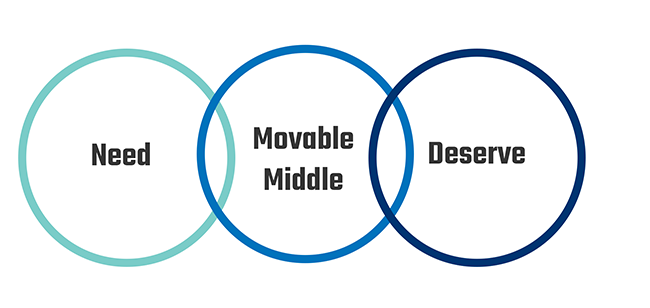
These are not perfect clients, but they have potential. Is there a chance that you are spending time with people who need you at the expense of the potential of the movable middle? Let alone the most deserving? Going forward, resist the temptation of bringing on clients that have no reasonable path to being ideal.
Strengthen Client Relationships with Proactive Communication
A call rotation for the most deserving, where you schedule two or three proactive calls a day to check in with your top 20%, and your protégé reaches out to the 80%, is a proven way to reduce interruptions, rejuvenate relationships and get out in front of developing opportunities so that you can capture more of them.
Measure Advisory Business Growth with Meaningful KPIs
The last quadrant is dedicated to assessing your growth on a meaningful and measurable basis. Personal and professional progress is relative and subjective. Your qualitative value has to be measured and appreciated as much as your quantitative is, so be sure that your Key Performance Indicators are in harmony.
This is where the feedback loop connects to the goals you've set. Ultimately it comes down to “as compared to what?” Are you where you used to be? Where are you, relative to peers and competitors? Where are you, relative to your potential?
On a professional level, a mission critical KPI is to continually assess your capacity. Little's Law is a fascinating premise that must be respected when it comes managing growth and capacity. Every growing enterprise has to be constantly aware of its capacity threshold and as far ahead of this as possible. Keep that front and center as you strive to reduce growth dependency on people and put more emphasis on practice and process.
If you look at a commercial jet closely, you will notice redundancy. There are generally two of everything, just in case. By creating an org chart of roles and responsibilities and a playbook of documented best practices, you are driving your enterprise value beyond recurring revenue and profitability because you are on your way to an IP-driven enterprise – with intellectual properties that someone would rather buy than build themselves. It’s a business that is not reliant on one person but rather can rely on any person who can execute a process. Your process and IP provide redundancy.
An IP mindset not only means that the business doesn’t reside in someone’s head, it also bridges you from a mindset of client service to one of client experience. At the risk of belaboring the point, client experience is thought out in advance. It anticipates needs and issues before they are presented, and is both scalable and proprietary.
Track Client Referrals and Advocacy Ratios
Among radio operators there is a term - “5-by-5” - which speaks to the volume and signal clarity of a perfectly transmitted message. A message has to not only be loud enough to hear, it has to be clear enough to comprehend. In business, it is important to track the improvement of the quality of referrals along with the quantity. It is important to look for patterns around the sources of introductions and frequency of individual advocacy, and the trends around the increase in client empowerment.
Engage Your Team in Business Performance and Growth
In your team meetings, engage everyone in being passionate about meaningful and measurable progress. Tie their compensation to three drivers:
Base Salary – for execution, fulfillment and maintenance of core competency outlined in the org chart – do your job and have it completely documented.
Bell Ringing Tip Jar – when the team moves the needle, everyone wins and participates in the lift through monetary rewards and celebratory events.
Guard your time, invest it well and always look at the silver linings when reflecting on your efforts.