


Insights from New Coaching Clients in 2026



What do successful financial advisors want from coaching today?
Increasingly, it isn't simply help generating more revenue or attracting more clients. Advisors are looking for something more fundamental: the systems, processes, team structure and capacity required to turn a successful financial advisory practice into a scalable business.
Over a 365-day period spanning Q4 2025 through Q3 2026, Pareto Systems gathered insights from 173 advisor and team questionnaires representing 107 financial advisory firms and practices that had chosen to work with Pareto's coaching programs during the year. The findings provide an interesting snapshot of the challenges facing advisors - both in the areas where financial advisor coaching can have the greatest impact and the reasons financial advisors sought coaching with us in the first place.
The overriding message was clear. Advisors aren't short on ambition. They're not short on opportunity or strong client relationships. Many are short on capacity. And that distinction has shaped many of our most important coaching conversations over the past year.
Here are the questions we heard and answered most often with new clients in 2026.
A Quick Summary of New Client Questionnaire Findings
Download the Coaching Onboard Questionnaires - Insights Report 2026
What Are the Biggest Practice Management Challenges for Financial Advisors?
One of the most consistent challenges identified through our coaching questionnaires was advisor dependency. Too much still flows through the lead advisor.
Advisors described businesses where they struggled to take a day off, spent too much time reacting, lacked control over their calendars, saw processes followed inconsistently and had team members waiting for direction rather than independently moving work forward. These might initially appear to be productivity or time-management problems.
They're usually something bigger. They're practice-management problems.
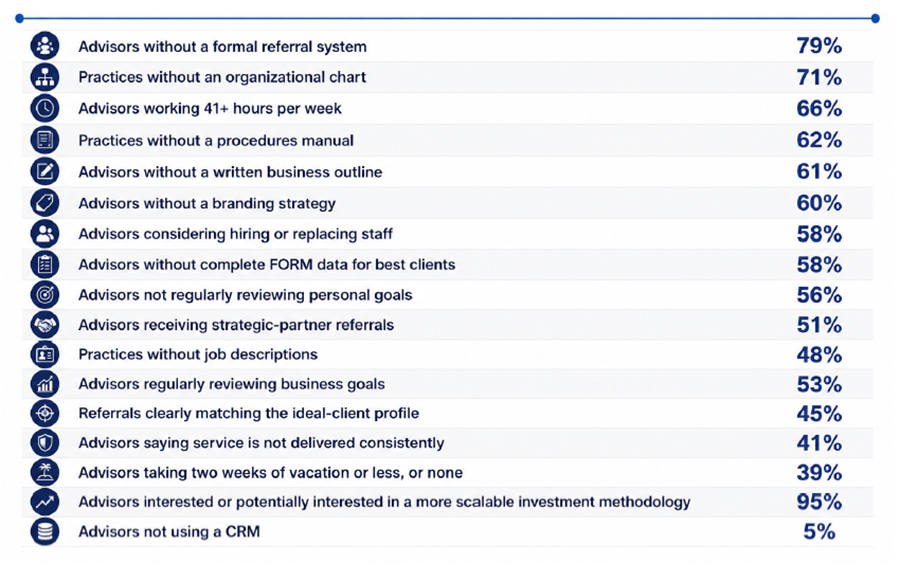
The numbers on the Questionnaire Findings list illustrate the challenge of Financial Advisors working with Pareto in coaching:
- 71% did not have an organizational chart.
- 66% of advisors were working 41 or more hours per week.
- 62% did not have a procedures manual.
- 48% did not have job descriptions.
- 41% said client service was not delivered consistently.
There is an important lesson in those numbers for any growing advisory firm: Being busy is not the same as being scalable. An advisor can have tremendous personal productivity and still own a business that remains almost completely dependent on that productivity.
The objective of coaching is to begin changing that equation.
How Can Financial Advisors Create Capacity for Business Growth?
Growth was the most frequently stated objective among participating advisors. But one of the most important insights from this year's coaching is that growth itself isn't necessarily the problem that needs to be solved first.
Many advisors are already operating near capacity while remaining deeply involved in client relationships, decision-making, business development and day-to-day execution.
So before asking: "How do we grow?"
We encourage advisors to consider another question: "What happens to our business if we grow?"
If another 10, 20 or 50 ideal clients arrived tomorrow, could your current team and processes absorb them? Or would that success simply create more work for you?
This is why effective coaching for financial advisors increasingly begins with capacity.
The 2026 findings identified several foundational priorities, including organizational charts, role descriptions, procedures manuals, KPI scorecards, client segmentation, delegation plans and calendar redesign. These aren't administrative exercises, they are the infrastructure of a scalable practice.

How Do You Build a Scalable Financial Advisory Practice?
Systems, processes, workflows and consistency emerged as the most frequently mentioned operational gaps and among the most common ways advisors defined success from coaching.
Advisors identified a need for more consistent:
- Client onboarding
- Review meetings
- Prospect qualification
- Follow-up
- Team workflows
- CRM activities
- Client contact schedules
- Meeting preparation
- Service standards
- Business-development activities
The common denominator is repeatability. If a process only works when the lead advisor remembers to initiate it, oversee it and ensure its completion, it isn't really a process. It's a habit dependent upon one person. Documenting and institutionalizing these processes can help move a firm from being advisor-dependent to team-enabled.
That's where scale begins.
How Can Financial Advisors Deliver a More Consistent Client Experience?
Growth isn't only about acquiring new clients. It's also about delivering a consistent experience to the clients you already serve. That is why another major area of financial advisor coaching in 2026 has been standardizing the client experience.
The coaching priorities identified in the report include client classification, defined service standards, a consistent review-meeting process and greater family engagement.
This matters because clients shouldn't receive an exceptional experience simply because their advisor happened to have a good week. The experience should be driven by the firm's process. When expectations are documented, responsibilities are clear and workflows are built into the business, consistency becomes less dependent on individual effort.
That helps create something increasingly valuable: A client experience attached to the firm rather than solely to the founder.
How Can Financial Advisors Get More Ideal-Client Referrals?
One of the biggest growth opportunities identified in the 2026 data involves referrals.
Seventy-nine percent of participating advisors reported they did not have a formal referral system, while only 45% said the referrals they received clearly matched their ideal-client profile. That suggests many successful advisors are benefiting from goodwill without fully harnessing client advocacy.
There is an important difference. Goodwill means clients are happy to refer you when the subject happens to arise. Advocacy means your best clients and strategic partners understand who you are ideally suited to serve, what makes your process distinctive and how to introduce you effectively.
That's why our coaching priorities include defining the ideal client, sharpening the value proposition, developing client advocacy, creating a referral process, strengthening strategic-partner relationships and improving prospect qualification and onboarding.
The objective isn't simply generating more referrals, it's creating more introductions that are the right fit.
How Should Financial Advisors Use Their CRM More Effectively?
Technology represents another interesting finding. Only 5% of participating advisors reported not using a CRM. That means CRM adoption itself isn't the primary issue; CRM utilization is. The coaching priorities identified in the report include CRM cleanup, mandatory client-data standards, and workflow configuration.
This distinction matters. Owning technology doesn't create efficiency any more than owning exercise equipment creates fitness. The value comes from utilization.
For a CRM to contribute to a scalable advisory business, it needs to become part of how the team operates: capturing meaningful client information, triggering workflows, creating accountability and helping ensure that important activities happen consistently.
The goal is to move from technology ownership to technology utilization.

When Should Financial Advisors Start Succession Planning?
Perhaps the most revealing part of our 2026 coaching data appears when advisors look beyond their immediate priorities and consider the next five years. The conversation shifts from personal production toward enterprise building. Advisors described aspirations to acquire books of business, partner with other advisors, create multi-advisor structures, build transferable businesses and transition leadership and ownership.
They also expressed a desire for greater lifestyle flexibility: working fewer days, gradually retiring, focusing on their best clients and remaining strategically involved without carrying the burden of daily operations.
That highlights an important principle of financial advisor succession planning: Succession isn't an event. It's a process. And the best time to begin making a business less dependent on its founder isn't six months before retirement.
It's years earlier.
How Do You Turn a Financial Advisory Practice into a Transferable Business?
That may be the most important takeaway as to why Financial Advisors started coaching with Pareto. The advisors participating in coaching aren't simply asking for another tactic. They're trying to change the nature of their businesses.
They want to move from reactive to intentional, from advisor-dependent to team-enabled, from informal to documented, from passive referrals to proactive advocacy, and from generic service to a defined client experience.
Ultimately, they want to move from a personal practice to a transferable enterprise with greater control, freedom and optionality. Those transitions are directly reflected in the conclusions of the 2026 Coaching Onboard Questionnaires & Insights Report.
Put another way, it's the progression from a book of business, to a business, and ultimately to an enterprise.
What Should Coaching Help You Accomplish?
The definition of a successful advisory practice is evolving, growth still matters, assets matter, revenue matters, and new clients matter - but they don't tell the whole story.
That's why the opportunity for coaching is bigger than helping financial advisors grow or become more productive, it's about serving ideal clients, creating capacity for sustainable growth, empowering the team and giving the advisor greater control over both the business and their future.
Download the Coaching Onboard Questionnaires - Insights Report 2026