


Why Financial Advisors Should Position Alternative Investments as Part of Their Process


Whether advisors offer Alternative Investments or not, advisors should have an opinion on them
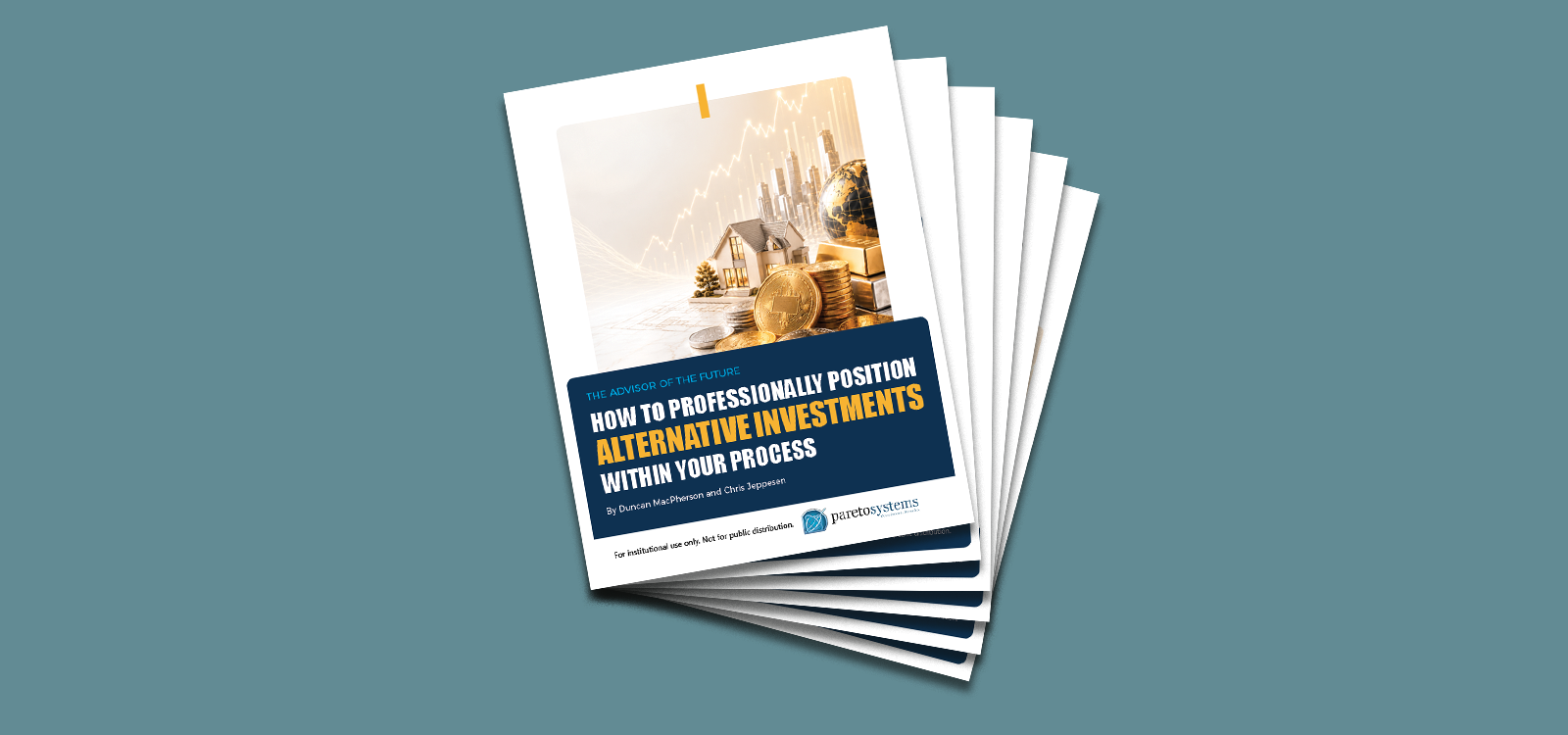
The following is an excerpt from the new white paper The Advisor of the Future: How to Professionally Position Alternative Investments Within Your Process by Duncan MacPherson and Chris Jeppesen
Alternative Investments for Financial Advisors: A Major Shift in Wealth Management
An expansive array of alternative investment options has exploded onto the scene, competing for your clients' attention and giving you an opportunity to level up.
Alternative investments (alts) sit at the intersection of investor curiosity, technological innovation, macroeconomic uncertainty, and the growing demand for access beyond traditional markets. As information becomes more accessible and private market opportunities become more visible, investors are increasingly exploring investments that historically existed outside their reach.
This evolution has significant implications for both.
Alternative investments have the potential to disrupt the traditional advisor-client relationship. Increasingly, clients are being exposed to private market opportunities through media, peer networks, podcasts, influencers, online platforms, and specialized investment providers. In many cases, these conversations are happening outside of the purview of their primary financial professional. This can lead to a disconnect that can become a fracture over time.
Yet, as is often the case, periods of disruption can also create opportunity.
This shift presents a powerful opportunity to elevate strategic relevance, rejuvenate existing relationships with affluent clients and influential strategic partners while growing further up-market to attract and better serve sophisticated clients with complex needs.
Many respected voices in the investment world now argue that the traditional 60/40 portfolio model, a blend of equities and fixed income, may no longer fully address the realities of today's investment environment. In its place, some have proposed a more diversified 60/30/10 framework, where the additional allocation represents alternative investments that have traditionally been perceived as existing outside of a retail professional's reach.
Many of these types of investments were reserved primarily for institutional clients, sovereign wealth funds, endowments, pensions and substantial family offices but have now been democratized to retail financial professionals and their clients.
And because the awareness for the private space has increased and become more mainstream, there are some eligible clients who have allocated alts well beyond 10%.
Considering that 87% of companies in North America generating over $100 million in annual revenue are private businesses (according to Torsten Slok, Apollo Chief Economist and data from S&P Capital IQ) one gets proportion for the magnitude of this space. There are over 10,000 private companies with various liquidity needs. In contrast, there are approximately 3,900 publicly traded companies.
There is a growing spectrum of alternatives that now includes private placements, private credit, infrastructure, real estate ventures, precious metals, digital assets, and other non-traditional opportunities - many with non-correlated returns - that are becoming increasingly attractive options for affluent investors seeking added diversification, inflation hedging and income generation.
The question is no longer whether clients will explore alternative investments. It is safe to say that more retail clients are aware of and interested in learning more about alts. The question is whether their current advisor will be part of that conversation.
The advisor of the future will not simply be a professional with access to the most products, but rather the professional who will be active in the segment to provide clarity, structure, education, strategic oversight and implementation in an increasingly fragmented investment landscape. Professional positioning ensures your clients understand your process and the full array of tools in your toolbox and, at a minimum, always seek your opinions and guidance first.

How Financial Advisors Can Stay Relevant in a Changing Wealth Management Industry
The goal of this white paper is to help expand your thinking around deepening your relevance and impact with your clients.
The advisory landscape is evolving rapidly, and the next five to ten years are likely to bring more disruption, commoditization, competition, and complexity than the previous twenty combined. Clients are changing. Access to information is changing. Investment opportunities are changing. Expectations surrounding value, guidance, and sophistication are changing.
The advisors most likely to thrive in this next era will be those who evolve from investment providers into strategic and panoramic coordinators of financial decision-making.
If nothing else, consider this a gentle reminder:
What got you here will not be enough to get you there.
Going forward, you have to be even more intentional about positioning yourself to become indispensable to your clients' total financial lives while simultaneously enhancing your professional contrast thus improving how you are perceived, valued, and ultimately described by the people you serve.
The process outlined here is designed to help ensure three critical outcomes.
1. Always Be the First Call
The most trusted advisors are always the first call a client makes before any meaningful financial decision, never after the fact.
This level of trust is not built solely through portfolio performance. It is earned through proactive engagement, expanded relevance, consistent client experience, strategic insight, and the ability to help clients navigate increasingly complex decisions that extend far beyond traditional investment management.
When alternative investments enter the conversation, advisors who fail to establish this positioning risk becoming reactive participants instead of proactive leaders. You've got access, now get active.
2. Achieve Total Client Engagement
As clients' lives unfold, their needs evolve.
Liquidity events, business exits, inheritances, real estate acquisitions and monetization, tax complexities, philanthropic ambitions, intergenerational planning, and private investment opportunities can reshape a client's financial trajectory. The closer you get to these money in motion events and the more diverse your solution set, the more likely a client will feel compelled to empower you fully and completely.
The advisor of the future develops a process that converts customers into totally engaged and fully empowering clients, remaining fully integrated into the client's entire financial world as these critical life and wealth events emerge. These are catalysts that can disrupt a relationship or strengthen it.
Having gaps in your solution set and process can put long term relationships at risk and undermine total client engagement going forward.
3. Expand Fee Worthiness
The most successful advisors shift the conversation away from cost and toward value. The client focuses on why you're compensated far more than how much you're compensated.
When clients clearly understand the depth and breadth of strategic oversight, coordination, education, risk management, and decision-making guidance being provided, they become far less concerned with what the advisor costs and far more appreciative for what the advisor is worth. Your ability to explain, compare, recommend and orchestrate alternative investments as part of your process creates an opportunity to elevate this value proposition significantly.
By helping clients thoughtfully evaluate and position alternative investments within the broader context of their financial lives, advisors can deepen trust, reinforce expertise, rejuvenate loyalty and expand their role from portfolio manager to indispensable strategic advisor.
Being the first call, achieving total client engagement and expanding your fee worthiness ultimately represent your scorecard that clients keep track of even subconsciously. Again, clients are not buying individual products from you, they're buying into your process that provides a bespoke level of integration, service and client experience.
Why Alternative Investments Are Becoming Essential to Financial Advisor Client Engagement
The insights, strategies, and approaches outlined in this white paper are drawn from countless coaching conversations with some of the most innovative financial professionals in the industry, those who continue to elevate and differentiate how they conduct themselves, communicate value, and deepen client engagement.
Your most sophisticated clients are being increasingly exposed to investment opportunities that they may currently perceive as existing outside of your core scope. Competitors can use alts as a wedge in an attempt to get the attention of your clients.
Of course, competitors are pitching alternatives as a trade without any awareness of your client's risk profile or overall financial plan. They will use sizzle to derail your clients to deviate from your disciplined and patient approach of singles and doubles rather than swinging for the fences.
There is an opportunity to deploy a line extension campaign - an approach that introduces alternatives as an enhancement to your deliverable - to professionally unveil your expanded process to your clients that can, at a minimum, help competitor-proof your relationships. Your enlightened opinions along with aligned positions can be a breath of fresh air that invigorates and galvanizes client appreciation.
Clients are increasingly looking for advisors who can help them zoom-out, think critically, evaluate opportunities objectively, and place emerging investments into proper strategic context.
Even when an advisor is not directly implementing a particular investment, the ability to provide perspective, due diligence frameworks, and strategic oversight dramatically increases perceived value and relevance. Said again, while others pitch alts as an idea, product or siloed trade, you can position them as a supplement to your overarching planning strategy and process.
How to Introduce Alternative Investments Without Pitching Products
Enlightened advisors do not pitch alternative investments as isolated products or speculative opportunities. Instead, they position them as part of a comprehensive process designed to demonstrate strategic flexibility while balancing wealth creation with thoughtful diversification.
This distinction is everything. Professional positioning elevates the advisor-client relationship.
Salesmanship, on the other hand, is often interpreted as being somewhat opportunistic, transactional and even coin operated.
Stewardship is experienced very differently. It reflects an approach that is collaborative, consultative and aligned with clients' long-term best interests.
You moved away from the broker model long ago when you became a bona fide advisor. While many of your competitors may revert back to salesmanship as they strive to represent alts to their clients (and yours), you have an opportunity to continue your progression to being a client's complete wealth manager.
Positioning also helps counter two significant challenges that quietly emerge in long-term advisory relationships.
How Financial Advisors Can Prevent Client Loyalty Fatigue and Strengthen Retention
Even highly satisfied clients can gradually become desensitized to the value their financial professional provides if the relationship becomes too familiar, predictable, static, or repetitive over time.
Thoughtful evolution within the professional's process helps restore client appreciation and reinforces ongoing relevance. On the other hand, relationships that are flat or fading can be at further risk in part because of the horsepower that is in client's hands in the form of artificial intelligence (AI). Their ability to consider their options and even go shopping by searching for and assembling information when they're feeling disenchanted in a professional relationship can tip them over faster than ever to defect to a new provider.
The enlightened advisor embraces technology rather than competing against it. A mindset of "coopetition means that you use technology to liberate you to do what technology can't do: be human, be sincerely interested in others and manage logic and emotions.
Expanding Your Financial Advisory Services Without Losing Focus
Many advisors hesitate to discuss alternative investments because they lack confidence and/or fear appearing to be moving outside their lane.
Ironically, avoiding these conversations can create an even greater problem: clients may conclude that their advisor lacks the perspective or capability to discuss and execute on increasingly important areas of modern investing.
Building Client Trust Through Fiduciary Alignment and Transparent Investment Advice
Charlie Munger said it best:
Show me the incentive, and I'll show you the outcome.
This principle applies directly to how advisors position alternative investments.
If a client senses, even remotely, that the primary motivation behind introducing an alternative investment is compensation, production, and personal gain for the advisor, the exercise can damage trust far more than it benefits productivity and strengthens a relationship.
Clients are incredibly perceptive when it comes to incentives.

However, when clients clearly understand that discussing alternative investments is part of your fiduciary mindset, your planning process and your commitment to helping them navigate all meaningful financial decisions, the conversation is received entirely differently.
In many cases, clients begin to feel that not embracing these discussions would actually represent a disservice to themselves.
That is a powerful shift in positioning.
That said, this approach requires patience. Positioning is not conducive to instant gratification the way pitching can be. It rarely moves the needle quickly. You can be the shooting star or you can be the steady burner when it comes leveling-up using alts. Ultimately the disciplined, methodical approach gradually coordinates with your overall process and is received more favorably. Play the long game. Believe in cause and effect. Professional activity leads to productivity. Planting seeds and future pacing your clients is the most effective approach.
Be directional, never transactional.
Again, Charlie Munger captured this idea perfectly:
The big money is not in the buying or selling, but in the waiting.
Patience, strategically applied, is often rewarded.
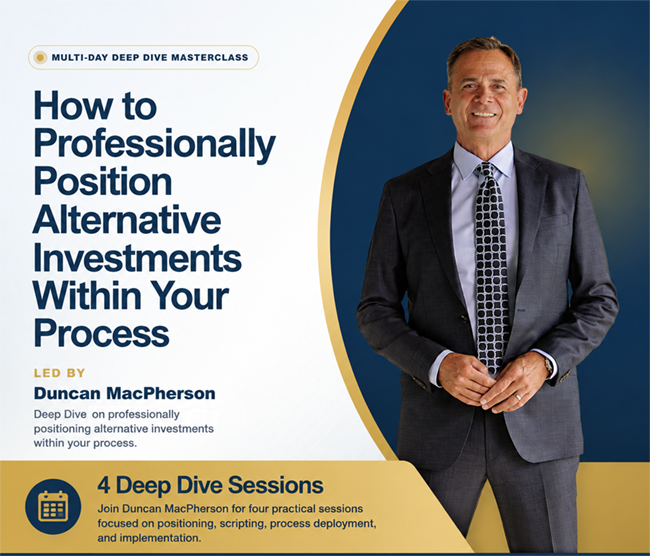
The Future of Alternative Invesments Oportunities for Financial Advisor Practice Growth
This guide and our Alternatives Investments Masterclass are excellent ways to start charting your course through the new frontiers of alternative investments, and how to best position the options to your clients.
This white paper is divided into the following chapters to dig deeply into specific areas of concern:
- A Seismic Shift
- Expanding Relevance
- Always be the First Call
- Achieve Total Client Engagement
- Expand Fee-worthiness
- The Writing is On the Wall
- Positioning, Loyalty Fatigue and Incentives
- Real World Signals from the Front Lines
- Innovation Requires Oversight
- It's All About Fit and Alignment
- From a Static Plan to Dynamic Financial Planning
- Eyes on!
- The Power of Process-Driven Trust
- Becoming More Referable
- The Opportunity Ahead
- Final Thoughts
- Risk Considerations
Deep dive on these points and more in the white paper, which you can download here.