

How Financial Advisors Build High-Performing Teams


From Forming to Performing
By Duncan MacPherson | Pareto Systems
"Some teams never develop past the storming phase. Not because their people aren't talented - but because their leader doesn't have a map."
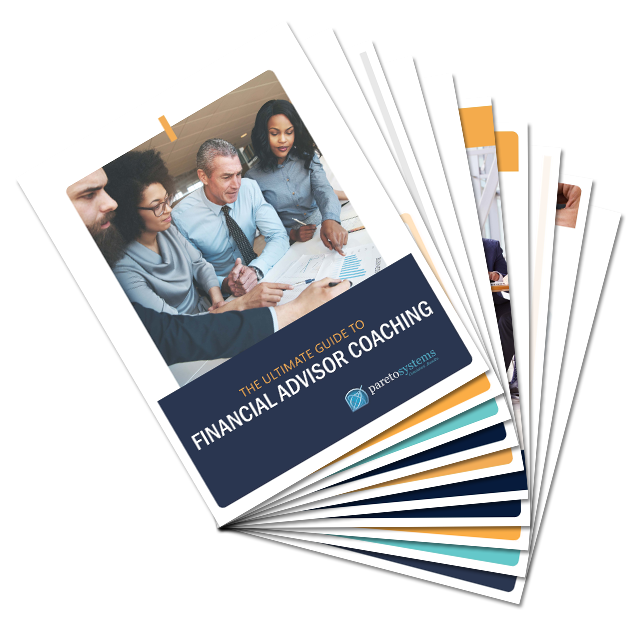
Get the PDF whitepaper here
Why Advisors Struggle to Build High-Performing Teams
Think of yourself as a conductor in an orchestra. Behind you, there's an entire audience, your clients, waiting for a world-class performance. But your real job Is to face the band. Every day, your job is to make sure the people on your team are harmonizing, that every instrument is in tune, and that what comes out the other end is something that moves people.
Most financial advisory leaders I work with are exceptional advisors. They built their practice through natural talent, persistence, and a refusal to quit. But when it comes to building and leading a team? That's where the drift begins.
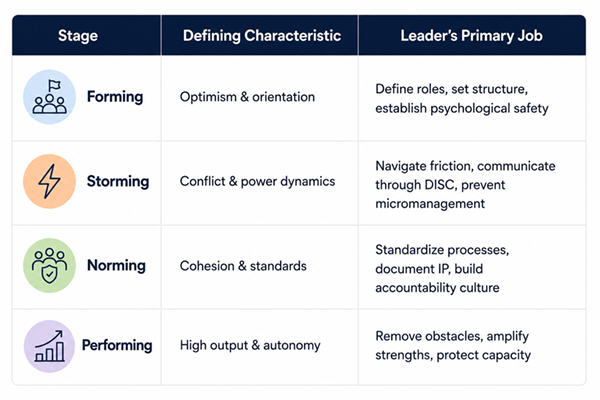
I've spent 30 years working alongside some of the best teams in the financial services industry through Pareto Systems. What separates the top performers from everyone else isn't talent, there's plenty of talent out there. What separates them is process. And one of the most powerful process frameworks any leader can internalize is Tuckman's model of team development: Forming, Storming, Norming, and Performing.
I reference this model in The Blue Square Method because it's not theory. It plays out on the ground in every advisory practice, every time a team adds a new member, takes on a new initiative, or navigates a leadership transition. If you don't know what stage your team is in, you're navigating without a map.
What will be Covered in this Article
- Why Most Teams Never Reach Their Potential
- The Four Stages of Team Development
- Stage One: Forming - Building a Strong Financial Advisory Team Foundation
- Stage Two: Storming - Where Most Teams Get Stuck
- Stage Three: Norming - Engineering Consistency
- Stage Four: Performing - What Real Leadership Has Been Building Toward
- The Role of DISC in Accelerating Every Stage
- The Leader's Playbook: Putting It All Into Action
- Running a Business, Not Just a Practice
Why Most Teams Never Reach Their Potential
Here's something I see all the time. A successful advisor builds a practice to a meaningful level of AUM. They add team members. They hire great people. And then" it stalls. There's friction. Miscommunication. People working around each other instead of with each other. The leader, frustrated, starts doing things themselves.
The problem isn't the people. The problem is a lack of deliberate leadership through the stages of team development.
Bruce Tuckman, an American psychology researcher, first documented these stages in 1965. His research concluded that all teams, regardless of industry, size, or experience pass through the same four phases. These phases are not optional. You can't skip them. You can only navigate them well or navigate them poorly.
Do you know how to lead them through?
The Four Stages of Team Development
Stage One: Forming - Building a Strong Financial Advisory Team Foundation
The Forming stage is the honeymoon phase. Everybody is on their best behavior. Optimism is high. Excitement is genuine. Your new team member, or your newly assembled group, is eager to contribute and reluctant to rock the boat.
During Forming, people are still figuring each other out. They're still oriented toward themselves, not yet toward the team. They want to understand: What is my role here? What are the rules? Who has authority? What does success look like?
This is your moment as a leader to create the clarity that carries the team through every difficult moment ahead.
What High-Performing Leaders Do in the Forming Stage
The best leaders I've observed treat the Forming stage as the most important architectural moment for the team.
You wouldn't build a skyscraper on an unexamined foundation. The Forming stage is your foundation.
Financial Advisor Team Building Checklist for the Forming Stage:
- Create a clear org chart with defined roles, even for positions not yet filled
- Articulate your team's vision, mission, and value proposition in writing
- Define your ideal client profile so everyone knows who you serve
- Establish communication norms: how do we run meetings, how do we flag issues, how do we celebrate wins?
- Introduce the Rule of Three: anything done three or more times, with three or more steps, must be documented
- Begin building your Procedures Manual, the foundation of your intellectual property
When people know exactly what lane they're in, they stop second-guessing and start executing.
Stage Two: Storming - Where Most Teams Get Stuck
Storming is where most financial advisory teams get stuck, sometimes for years. It's where personality clashes emerge. Where unspoken frustrations surface. Where the leader, overwhelmed, makes the fatal mistake: they start doing it themselves.
Tuckman's research found that roughly half of the teams he studied experienced conflict in this phase. The other half either moved through it quickly or bypassed it entirely, not because they were better people, but because they had better systems.
Here's what makes the Storming stage so dangerous for advisors specifically: you are wired for risk aversion. It governs you, even subconsciously. And nothing triggers that risk aversion more than watching your business feel like it's going sideways. So you micromanage. You stop delegating. You say, "I'll just do it myself, it's faster."
That instinct will cost you more than you know.

The Micromanagement Trap
Micromanaging is one of the most undermining things a leader can do during the Storming phase. I've seen talented advisors, people who have everything it takes to build a remarkable enterprise, cripple their teams by refusing to let people make mistakes.
When you swoop in and fix everything, you're not protecting your business. You're engineering a team that cannot function without you, which is the exact opposite of what you need to build.
Embrace calculated risk. Let people make recoverable mistakes. That's how you build a team.
The Communication Breakdown
Most Storming-phase conflict isn't about bad intentions. It's about different communication styles colliding without a framework.
This is where understanding DISC becomes one of your most powerful leadership tools. DISC defines four primary communication styles: Dominant, Influential, Steady, and Conscientious. Every person on your team has a dominant style, and every interaction between mismatched styles has the potential to generate friction.
Your high-D advisor might read your high-S support staff's hesitation as resistance, when in reality they are taking time to consider the impact on others and ensure stability. A high-I team member may dominate a discussion with enthusiasm and spontaneity, inadvertently leaving a more analytical high-C colleague feeling unheard or without enough information to contribute. None of this is character failure. It's just wiring, and wiring that, once understood, can be channeled productively.
The leaders who move through the Storming phase fastest are the ones who invest in helping their teams understand each other. A DISC assessment and a facilitated debrief is one of the highest-ROI investments you can make in the life of your team.
Leadership Mindset: Are You Building or Draining Your Advisory Team?
Every leader I've worked with is either a fountain or a drain. A fountain of optimism, clarity, and encouragement, or a drain of negativity, anxiety, and doubt. During the Storming phase, your team is looking to you for cues. If they see a leader who is anxious, reactive, and territorial, they will match that energy. If they see a leader who is steady, curious, and solutions-oriented, they will rise to meet that too.
The best leaders I've observed always own the loss and give away the win. That posture, that combination of humility and confidence, is magnetic. It builds trust faster than any team-building exercise ever will.
From The Blue Square Method:
"Circumstances don't make the man, they reveal him. Your resolve as a leader, your ability to cope and apply some judo, harnessing the energy of disruptions and having it serve you, it's a lost art."
Stage Three: Norming - Engineering Consistency
When a team moves from Storming to Norming, something remarkable happens. The air clears. Collaboration replaces competition. A shared identity begins to emerge.
But here's a warning: the Norming stage has its own trap. Teams can become so focused on maintaining the peace that they stop offering the ideas, observations, and concerns that drive progress. Harmony becomes more important than honesty.
The leader's job in the Norming stage is to capitalize on the cohesion that's been built and channel it into process.
Why Documented Processes Are Essential for Financial Advisory Teams
Your team's greatest collective asset isn't your AUM. It's your intellectual property - the documented and refined processes that define how you serve clients, onboard new relationships, and run your practice.
There is a rule in practice management called the Rule of Three: anything you do three or more times, with three or more steps, must be documented. It cannot live in someone's head. Because the moment it lives only in someone's head, you've made yourself, or that person, irreplaceable in the worst possible way.
During the Norming stage, your team has enough trust and shared language to build this together. This is the moment to create your Best Practices Playbook. Document your client fit process, your onboarding workflow, your service model, your communication cadence. Every investment of effort your team makes in this direction builds enterprise value, improves scalability, and strengthens your succession plan.
How Financial Advisors Build Accountability Without Micromanaging
Accountability is one of the most overused and under-delivered words in business. Most teams confuse accountability with blame. They're not the same thing.
Accountability in the Norming stage looks like this: every team member knows their role, has the tools to execute it, and is part of a regular rhythm of review. Weekly team meetings. Monthly deep dives. Quarterly off-site meetings. Annual planning sessions. This isn't bureaucracy. It's precision, and it says, "This is not transactional. This is directional. We are building something together."
The incrementalism compounds. That's how you reach inflection points, not through heroic individual effort, but through the quiet, relentless accumulation of good process.
The Four "Ables": Your Norming Stage North Star
In The Blue Square Method, I describe four qualities that every high-performing advisory practice must embody. Think of these as the destination the Norming stage is taking you toward:
- Predictable: Your client experience is consistent. Your team operates from documented processes, not memory. There's no drama, because accountability is built in.
- Sustainable: Nothing falls through the cracks. Nothing depends on any one person being present. Your processes are repeatable, your client relationships are protected.
- Duplicable: You could hand your playbook to a qualified new team member and they could execute your process. Your IP is independent of individual talent.
- Scalable: You can grow without diluting the client experience or burning out your team. Every new client you add strengthens rather than strains your operation.
When your team hits all four of these, you've done your job in the Norming stage. You're ready for what comes next.
Stage Four: Performing - What Real Leadership Has Been Building Toward
Performing teams are rare. I've had a front-row seat to enough of them to tell you that when you experience one, it's unmistakable. There's a quality to the environment that you can feel walking through the door.
People are competent. They're autonomous. They make decisions without needing to check with you at every turn. They surface issues proactively instead of waiting for problems to fester. Dissent is welcome and productive, channeled through constructive dialogue rather than passive resistance. The business doesn't run the leader, the leader runs the business.
And here's what's fascinating: the leader of a Performing team is often the calmest, most unhurried person in the building. That's not accident. That's architecture.
Depersonalize to Scale
When your business is productive, consistent, and predictable whether you're present or not, that's when you've truly built something. Your clients aren't dependent on your personal presence for every interaction. It's not the "Julia show." It's a practice. An enterprise. Something with a life of its own.
Depersonalization drives enterprise value. It strengthens your succession plan. It makes your business worth more, to a buyer, to a successor, to your clients' next generation. Every team that reaches the Performing stage is a team that has learned to build something bigger than any one individual.
How Leadership Changes as Your Advisory Team Matures
In a Performing team, your job changes. You move from technician to strategist. From operator to architect. You're no longer solving every problem, you're designing systems that prevent problems from arising in the first place.
The best leaders in the Performing stage spend most of their leadership energy on three things: protecting their team's capacity, amplifying what's already working, and continuously elevating the standard.
Critically, understand that even high-performing teams can regress. A change in leadership, a new team member, a major shift in market conditions, any of these can push a team back into Storming. That's the nature of human systems. Your job is to know where your team is, always, and to lead them through whatever phase they're in with intention.
The Role of DISC in Accelerating Every Stage
I want to spend a moment on DISC because it's one of the most underutilized leadership tools I see in the advisory space. Leaders will spend hundreds of thousands of dollars on technology and virtually nothing on understanding the behavioral wiring of their own team. That imbalance costs them dearly.
DISC isn't a personality test. It's a map. It helps you understand how each person on your team prefers to communicate, what motivates them, and what environments allow them to perform at their best. That knowledge is indispensable at every stage of team development.
In the Forming stage, DISC helps you design a team with intentional complementarity, people whose styles balance rather than duplicate each other. In the Storming stage, it's a translator. It helps you reframe conflict as communication style differences rather than character flaws. In the Norming stage, it informs how you structure roles, meetings, and feedback. In the Performing stage, it helps you maintain motivation and engagement as individual needs evolve.
Have every member of your team complete a DISC assessment. Book a facilitated debrief. Then, and this is the part most leaders skip, create a team communication guide that everyone can reference. Not once. Continuously. Make it a living document in your Procedures Manual.
The ROI on this investment will show up in fewer misunderstandings, faster resolution of friction, and a team that feels genuinely seen and understood by their leader. That last part matters more than most leaders realize.
The Leader's Playbook: Putting It All Into Action
Understanding the four stages is necessary. Acting on that understanding is what separates the best from the rest. Here's how to translate Tuckman's framework into your daily leadership practice.

Know Where Your Team Is Right Now
Sit down this week and honestly assess what stage your team is in.
Your honest answers will tell you exactly where your leadership energy needs to go.
Schedule Everything
One of the most powerful laws in leadership is this; the business doesn't run the leader, the leader runs the business. And practically speaking, that means you schedule everything.
Allocate Your Time with Intent
Classify your advisors as coasting, cresting, or climbing. The coasters have chosen minimal adaptation. The cresters are still growing but are on a collision course with their own capacity limits. The climbers are self-motivated, hungry to get to the next level.
Your climbers deserve more of your one-on-one attention and energy. Your cresters need a structured program that helps them see and address their blind spots. Your coasters need honesty, and sometimes, that means the conversation about whether this is the right fit going forward.
You cannot afford to allocate the same resources to everyone. That's not unfair, that's leadership.
Counter the Law of Diminishing Intent
Every great conversation, every insight, every commitment to change begins to lose its power the moment it ends, unless it's followed by immediate, concrete action. This is the Law of Diminishing Intent, and it is the silent killer of team development.
The antidote is simple: every interaction must end with an accountable next step. A specific action, assigned to a specific person, with a specific deadline. That discipline, practiced consistently, is what transforms your meetings from interesting conversations into engines of actual progress.
Running a Business, Not Just a Practice
There is a profound difference between having a practice and running a business. A practice can provide a great lifestyle and a great living. But when you make the shift from managing a book of business to leading an enterprise, everything changes.
You deepen your legacy. You expand your reach. You create something that outlasts you and continues to serve your clients' families long after you've exited the day-to-day. You build enterprise value that reflects not just what you've earned, but who you've become and what you've built.
Tuckman's model isn't just a framework for managing team dynamics. It's a framework for becoming the kind of leader who can build that enterprise.
The best time to internalize this framework was the day you hired your first team member. The second-best time is today.
Download the Leadership Playbook "From Forming to Performing'
About Duncan MacPherson and Pareto Systems
Duncan MacPherson is the CEO of Pareto Systems and the author of The Blue Square Method and The Advisor Playbook. For over 30 years, he has worked with financial advisory teams across North America to help them build predictable, scalable, and deeply fulfilling businesses. Pareto Systems currently maintains over 250 active coaching and consulting engagements with high-performing advisory teams.

If the ideas in this post resonated with you, we'd love to explore how Pareto Systems can serve as your accountability partner and navigational guide as you build the enterprise you've envisioned.
paretosystems.com | Connect with Duncan on LinkedIn